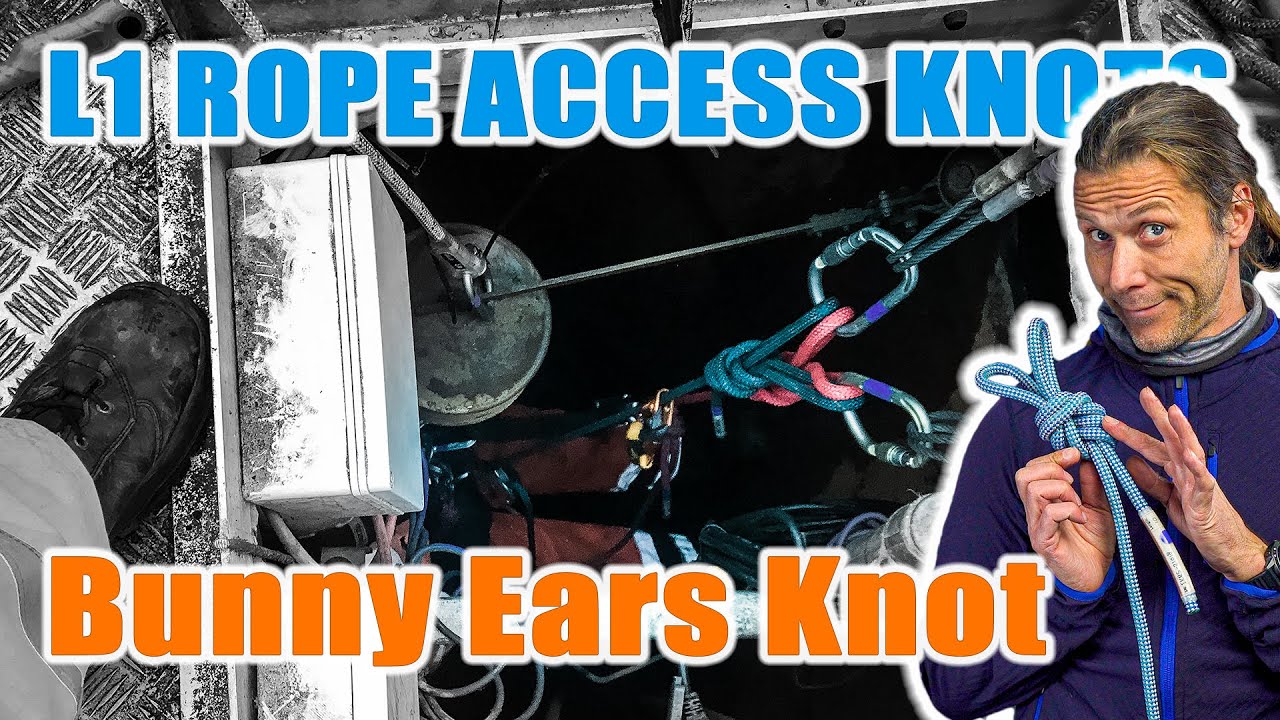
How to Tie a Bunny Ears Knot: A Rope Access Expert’s Guide
Introduction
In the dynamic world of rope access, mastering a variety of knots is crucial. Today, we delve into the Bunny Ears Knot, a versatile and essential knot for any rope access professional. This knot, also whimsically known as “The Playboy Knot,” is not just practical but also has a unique charm.
Watch the full video on Youtube, link at the end of the article
Ashley’s Insight
Clifford W. Ashley, in his seminal work “The Ashley Book of Knots,” refers to this knot as the Double Figure of 8, listed under #1085. Ashley describes this knot as a reliable and adjustable solution, ideal for various applications. His detailed exploration provides a foundational understanding of its importance.
#1085. A rigid Double Figure-Eight Loop.
The loops are narrow and parallel. Double your rope and tie
the looped end in the form
of a figure eight but without making a final tuck. It should coincide

with the left diagram. The loop that was formed should be laid back
underneath against the doubled standing part which is to form the
neck of the knot. See the right diagram. Two bights from the neck
of the single loop are then grasped (third diagram) and pulled down
through the Double Loop. Draw up evenly to form the knot pic-
tured in the center.
Step-by-Step Guide: Tying the Bunny Ears Knot
Let’s break it down:
1. Start with a Figure 8: Initiate with a basic figure 8 knot on a bight of rope.
2. Form the Ears: Create another bight from the tail end, threading it through the last loop of the figure 8.
3. Final Adjustments: Dress the knot by adjusting the two loops to ensure they are even and secure.
Rope Access Applications
The Bunny Ears Knot is invaluable in rope access, especially when using a two-rope system. It’s ideal for creating secure and adjustable anchor points. Whether you’re engaged in high-rise window cleaning or complex industrial tasks, this knot offers reliability and versatility.
“Empirical” 😉 Testing by HowNot2
Ryan from HowNot2 conducted thorough tests on the Bunny Ears Knot, highlighting its strength and reliability even after heavy loading. His tests demonstrate that it is easier to untie compared to a standard figure 8 knot, making it highly practical for rope access work. For an in-depth analysis, check out Ryan’s article on HowNot2
Tips for Mastery
1. Practice Regularly: Familiarize yourself with the knot through consistent practice.
2. Safety Checks: Always double-check your knots for added safety.
3. Continuous Learning: Stay informed about the latest developments in rope access techniques and safety standards.
Conclusion
The Bunny Ears Knot is a testament to the ingenuity and adaptability of the rope access community. It’s a practical tool that enhances safety and efficiency. Embrace this knot and see how it transforms your rope access endeavors.
Click the title to head over to watch the full video:
How to tie the bunny ears knot
Like and . Turn on notifications to never miss a new upload!
If you have any questions and/or suggestions, ask away in the COMMENTS 🙂
This video is sponsored by:
Industrieel Klimmen –
Your one stop shop for all things rope access.
Use coupon code: TRAC at checkout for a €20,- discount with any purchase of over €100,-
Connect on:
Patreon:
Website: https://www.theropeaccesschannel.com
Email: connect@theropeaccesschannel.com
Instagram: https://www.instagram.com/theropeaccesschannel/
Twitter: https://twitter.com/theropeaccessc
Facebook: https://www.facebook.com/theropeaccesschannel/
lineGrip lineScale 3
https://www.linegrip.com/?ref=TRAC
A revolutionary digital all-in-one bluetooth dyno / load cell. PPE certified, 1280Hz fast, 30kN WLL, and unique onboard-logging of up to 50 hours. The huge load eyes and 90kN breaking strength make it perfectly suited as a generous master point for any type of rigging challenge.
LS3 Affiliate discount code:
Use code TRAC-dFZ-55s on checkout to get 2,5% discount!!
Use for any purchase on Linegrip and support the channel
I use Tubebuddy to manage this channel:
https://www.tubebuddy.com/LXB
No responses yet